- Culinary Schooled
- Season 1
- Episode 2
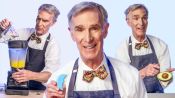
Can Bill Nye Cook?
Released on 06/06/2023
This is not scoopable stuff.
This is a failure.
Greetings.
I'm Bill Nye, mechanical engineer.
I'm here at Bon Appetit where they're gonna present me
with some cooking challenges.
And I think the question for everyone, can Bill cook?
Let's get chopping.
Make stovetop popcorn.
Do not burn any popped kernels.
Cannot have more than 15% of kernels unpopped.
I make stovetop popcorn all the time.
This looks like, I gotta say, the absolute minimum
amount of oil that would work in Le Creuset.
So you look at it and you'll see the oil
take on a little somethin' somethin'.
And hard cores might put in a few kernels
and wait for one to pop.
'Cause what makes the kernel pop
is water inside the popcorn kernel turns to steam
and that catastrophic explosion
turns the kernel inside out and makes the delicious,
uniquely American, fabulous snack of popcorn.
There we go, there's one.
So that's probably it.
100 grams, in we go.
See, I'm gonna shake it
to try to spread 'em out a little bit.
When I put in those kernels, it cooled it off fast.
I'm surprised that more of 'em aren't popping.
There you go.
Just looking at these kernels,
I'm not here to judge,
but I don't think these are Orville Redenbacher.
These look like Bang-O or Jolly Time
because of the size of the kernel.
Even that one, I don't think it's Orville.
I'm open-minded.
Stovetop is better.
I did the air popper, that fad.
The air popper is just less.
It doesn't heat the kernels up quickly enough.
What we would want is just violent, pop, pop, pop, pop, paw.
The mass of this cast iron is such
that the hot plate can't quite keep up.
So we get down here near the end and you gotta do it by ear.
You know what they say
about the poor carpenter who blames his tools?
It's a Le Creuset.
I mean, come on, people.
We have to get 15%.
We're going for it.
It's our number.
We're going for it.
There are no burned kernels.
You see that?
Don't make me come over there.
No burned kernels.
I know we have to weigh these,
but I would like to eat a couple.
So at 100 grams, we gotta get fewer than 15.
We're at 16.
I came that close.
If I had it to do again with this tool,
this wouldn't happen.
I'd let it get a lot hotter.
I failed, but not by much.
You know what we say in engineering school?
What's the key to getting through engineering school?
Partial credit.
Partial credit.
Woo!
Cut and slice an avocado.
Cleanly remove the pit.
Cut slices to 1/2 centimeter thickness.
We'll cut it longitudinally.
What I like to do is roll the avocado
so you get the whole thing sliced,
and then we gently wiggle and it comes apart.
And then the key here, everybody, is the scoop.
Steady.
Steady, careful.
And then we'll go for the pit gently, carefully.
Then we scoop here with the same tool.
They want half a centimeter.
That's pretty thin, peoples.
It's really good to come this way.
Well, I don't have a sushi knife.
I'm not a sushi chef, but a couple of these aren't bad.
And you can see, I got better as it went.
I did okay.
The half centimeter is a challenge.
I would claim that if we were at home
and my house guests were presented with these,
they'd be okay.
Separate an egg.
Completely separate egg white from yoke.
No shell residue allowed.
My grandmother was French,
and she would take it [mumbling in French],
and use the shell and do it.
But I see that we have a perforated spoon.
Also provided us, uniquely slotted spoon.
The viscosity of the white.
It has to be sheared, almost cut away from the yolk.
You gotta break the shell,
and you gotta get through the membrane.
Three, two, one.
Yeah, it's pretty good.
There goes the white.
We're preserving it in the situation here.
I've never used a spoon, but I'm feeling great about it.
Yeah, okay.
Calling that white, and I'm calling that yolk.
Now, if they're not happy
with that tiny bit of white there.
So I think I'm calling that success.
Make blender mayonnaise from scratch.
Don't break the emulsion.
Mix to thick and creamy consistency.
Texture should hold its shape when scooped like mayonnaise.
It cautions me.
You, us.
Don't break the emulsion.
So I think we gotta go gently.
My confidence level is low.
Mayonnaise is gonna have egg yolks, little acid.
And then this is all this oil we add.
And because they're providing me
with both a lemon and a vinegar,
it provides with this fabulous lemon squeezer.
So we'll do a little lemon juice.
Now, when you cut, everybody, I know we're in a hurry,
but just can we curl your fingers?
Is that asking a lot?
And we're gonna crack the vinegar,
and we'll gently put these in.
Okay, that's doing okay.
Tore it up pretty good.
To get the emulsion going,
we'll add just a schmink of lemon juice.
A schmink is not very much.
This is a vinegar.
Emulsify it a little bit.
We'll put in a little mustard.
Let's add oil slowly.
So that's not good.
That's not good.
Look, they left this center out.
Bill predicts that's not a coincidence.
Well, look at that white color.
But there, the separating.
See that?
Steady.
Steady.
If you're gonna get a whip, you know, a spoonable whip,
you're gonna need more jolt.
But then you have to ask yourself,
if you're like me, and I know I am,
if it needs more acid.
We can add acid later
because we were able to get all this oil in there.
Am I feeling great?
No, I wouldn't say so.
[blender whirring]
Now, I'm reluctant to stop it
because if you let it separate, you're headed for trouble.
We need more acid.
And I know what many of you are saying.
You're saying, Bill, it just looks way too liquidy,
doesn't it?
And I'm hoping for that sound.
You know the sound?
You'll stop.
Is that what you said?
This is not scoopable stuff.
This is a failure.
So what I wanna do is talk to head chef
and find out what the deal is.
[Chef] Too much liquid, too fast of a stream.
The blender wasn't going fast enough.
Blender wasn't going fast enough.
All right, well, this will be a life skill we'll work on.
So let's call that a fail.
Filet a rainbow trout.
Remove one filet from the bones.
Cuts should be smooth.
What do you think this is called?
It's a fish filet knife.
What you do normally is start here
at the exit and work all the way to the end.
I have cooked a lot of fish,
but I have not fileted many fish raw.
The bones, in my opinion,
are more easily separated from the flesh after cooking.
My confidence level's low.
Conference level's low here.
And they want smooth cuts
instead of what might be catastrophic cuts.
See that?
That's just what they didn't want, those flaps.
The tip of this knife is real good.
Tip of this knife's real good.
Do you talk to yourself?
No, I don't talk to myself.
I don't feel more optimistic.
I had one good stroke,
but I might call it the exception rather than the rule.
You know what we say in construction?
You wanna let the tool do the work.
Come on, baby.
So here is my filet of a raw rainbow trout.
And it's okay.
There was one bone, and then this is too thin.
You don't wanna have those extra cuts aesthetically.
Also for cooking,
that's gonna cook faster than the other part.
But as a first cut, see what I did there?
I did my best, man.
I did my best.
Decorate a cookie.
Completely fill in a cookie
with icing to the edge without going over.
Icing needs to be even, no peaks or valleys.
Wow.
If this were a cooking show, I'd say,
here's one I prepared earlier.
Here are our shapes.
A sea star, moon, as seen from the Earth.
I guess this is the planet Earth.
It's the blue planet.
It has a lot of ocean.
Okay, so then we'll check the viscosity of this icing.
God, it's ideal, I gotta say.
So I'm doing the round one first
'cause it seems to me
that this would be the straightforwardest of the shapes.
See, when you get near the middle, gotta slow it down.
The star is gonna be a little more challenging.
But people have said to me,
Bill, are you a professional pastry chef?
And so far I've said, No, no.
But who knows where this will lead.
Less is more to begin with.
And when you're working in the middle,
like, see that last blob?
That's getting in a hurry.
Steady.
Steady.
If we had our own bakery, we'd say, Well, look at this.
This is factory, but these, they're artisan.
Charge a little more for these.
Oh look, I've been presented with culinary school diploma.
I think I earned it if I understand it.
I provided a few minutes
of not unwatchable television and I learned something.
Man, I'm gonna try the mayonnaise thing.
I'm gonna learn that.
Drizzle slowly.
Thanks for watching.
Are we still rolling?
You guys, I do not have product endorsement.
I have visited the Jolly Time factory.
I have a Jolly Time baseball hat.
Love the Jolly Time.
But when it comes to popcorn, it's a Venn diagram.
The circles, you know, the circles.
It's either Orville Redenbacher or it's not.
Just, I'm just saying.

Madelyn Cline Attempts 8 Basic Cooking Challenges
Can Bill Nye Cook?
Terry Crews Attempts 6 Basic Cooking Challenges

Kendra Makes Skillet Cheesesteak
Chris Makes Steak With Umami Butter Sauce

Recreating Bobby Flay's Cheddar Black Pepper Waffles From Taste

6 Pro Chefs Make Their Favorite 15-Minute Meal

6 Pro Chefs Make Their Go-To Egg Recipe

Perfect Mashed Potatoes With Crispy Potato Skins
Make A Perfect Pear Galette With Exceptional Ease


